

Why Does Whale Feeding Behavior Matter?
Provided by: American Museum of Natural History|Published on: September 18, 2025
Grades: 9, 10, 11, 12
Type: Videos
Subjects: Biology
Authors: American Museum of Natural History
Region: Global
Languages: English
This resource has been reviewed by SubjectToClimate's climate scientists and verified for scientific accuracy and up-to-date information. Learn about our review process →
This resource has been reviewed by SubjectToClimate's climate scientists and verified for scientific accuracy and up-to-date information. Learn about our review process →
Synopsis
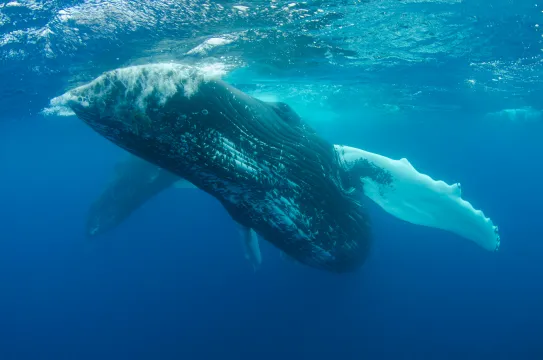
- In this video from the American Museum of Natural History, students will understand the importance of the research following the feeding patterns of blue whales.
- Students will get an idea of how climate change and warming oceans may impact whales and their ability to feed on krill.
Teaching Materials
Positives
- This video includes graphics and images that help support students' understanding.
- Students will get to hear from researchers and professors and get a glimpse of what it is like to do this kind of research.
Prerequisites
- Students should have a basic understanding of the effects of global warming on the ocean.
Differentiation & Implementation
- Teachers can pause the video at about 2:55 and ask students to infer the meaning of specialist as it is used in this video. Teachers can then have students discuss how population changes may be more impactful for species that are specialists.
- To expand on the impacts of climate change on the ocean currents, teachers can check out this resource.
- An excellent follow-up to this video to extend the discussion about ocean plastics is this unit. Students can also take some time to think of or record all the single-use plastics they encounter over the course of a day.
- Teachers can connect this video to the UN Sustainable Development Goal 14, Life Below Water. This video can help define this goal.
This resource features extensive interviews with scientists engaged in researching blue whale feeding behavior. Conservation and future uncertainty in whale populations due to climate change are the focus. Throughout, videos of research expeditions are included. This resource is recommended for teaching.
Teaching Tips
Standards
Resource Type and Format
About the Partner Provider

American Museum of Natural History
The American Museum of Natural History is one of the world’s preeminent scientific and cultural institutions. Since its founding in 1869, the Museum has advanced its global mission to discover, interpret, and disseminate information about human cultures, the natural world, and the universe through a wide-ranging program of scientific research, education, and exhibition.
Scientist Reviewed
This resource has been reviewed by SubjectToClimate's climate scientists and verified for scientific accuracy and up-to-date information. Our review process ensures that every resource in our library reflects the current state of climate science.
Learn about our review process →