
Strawberry No-Crush Challenge
Provided by: Center for Ecoliteracy|Published on: October 28, 2022
Grades: 3, 4, 5
Type: Lesson Plans
Subjects: Science, Social Studies, English Language Arts
Authors: Center for Ecoliteracy
Region: North America, USA - West, United States, California
Languages: English
This resource has been reviewed by SubjectToClimate's climate scientists and verified for scientific accuracy and up-to-date information. Learn about our review process →
This resource has been reviewed by SubjectToClimate's climate scientists and verified for scientific accuracy and up-to-date information. Learn about our review process →
Synopsis
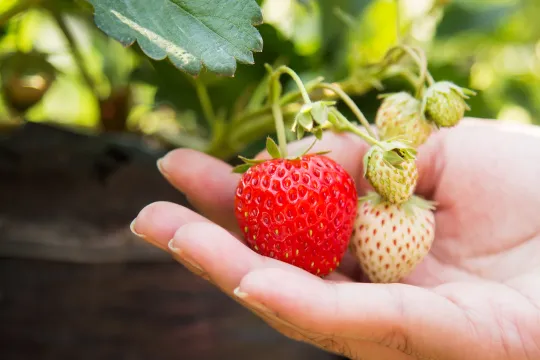
- This resource includes both a lesson and design project, comparing fresh and thawed frozen California-grown strawberries and challenging students to develop a way to transport fresh strawberries without crushing them.
- Students engage in reading comprehension, class discussions, critical thinking exercises, and a design challenge to learn about where our produce comes from.
- Students will familiarize themselves with strawberries grown in Santa Barbara, Orange, Ventura, San Diego, Monterey, Santa Cruz, Fresno, and San Luis Obispo counties.
Teaching Materials
Positives
- Students are introduced to new vocabulary, including terms like an achene, botanist, and perennial.
- The lesson plan includes discussion questions, an assessment rubric, and a step-by-step guide on preparing and conducting the design challenge and experiment.
Additional Prerequisites
- This lesson is expected to take two to three 50-minute periods.
- Students will need materials like serving trays, timers, measuring tape, and strawberries. A complete list of materials can be found in the lesson plan.
- Terms like runners, perennials, and seeds may need to be defined for students. A glossary can be found at the beginning of the lesson plan.
Differentiation
- If any students in the class are allergic to strawberries or if they are not accessible, the activity can be completed using blackberries or another berry.
- This resource can also be used in health classes during lessons about the nutritional value of fruits and where our food comes from and in science classes during lessons about agriculture.
- Have students consider what happens when food transportation is not well designed.
- For more resources on agriculture, check out this lesson plan on food production and this lesson on tomatoes.
This resource is a lesson that aims to show students how difficult is to deliver fresh produce to stores without damaging it but having them design their own way to transport them. It also contains information on the history of strawberries. This resource is recommended for teaching.
Teaching Tips
Standards
Resource Type and Format
About the Partner Provider
Center for Ecoliteracy
The Center for Ecoliteracy advances the teaching and modeling of sustainable practices in K–12 schools. The organization builds partnerships and the capacity of K–12 schools to support healthy, sustainable school communities and food systems change in schools. The Center for Ecoliteracy leads systems change initiatives, publishes original books and resources, facilitates conferences and professional development, and provides strategic consulting. The organization works at multiple levels of scale, with local, regional, state, and national programs.
Scientist Reviewed
This resource has been reviewed by SubjectToClimate's climate scientists and verified for scientific accuracy and up-to-date information. Our review process ensures that every resource in our library reflects the current state of climate science.
Learn about our review process →