

"Proxies for the Past"
Provided by: Jill Pelto Gallery|Published on: April 27, 2021
Grades: 6, 7, 8, 9, 10, 11, 12
Type: Artwork
Subjects: Earth and Space Sciences, Visual and Performing Arts
Authors: Jill Pelto Gallery
Region: Global
Languages: English

This resource has been reviewed by SubjectToClimate's climate scientists and verified for scientific accuracy and up-to-date information. Learn about our review process →
This resource has been reviewed by SubjectToClimate's climate scientists and verified for scientific accuracy and up-to-date information. Learn about our review process →
Synopsis
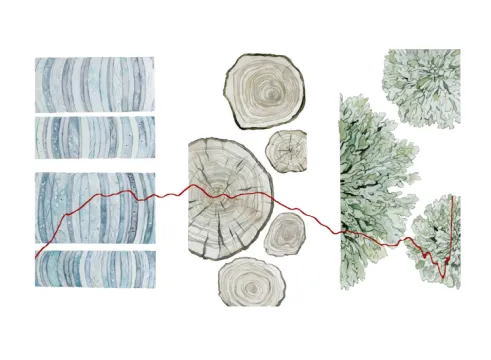
- In this watercolor and colored pencil piece, scientist and artist Jill Pelto, depicts tree rings, ice cores, and lichens, all of which help scientists reconstruct past climates.
- The artwork introduces students to paleoclimatology, the study of the Earth's past climate and average global temperature using natural materials, fossils, or elements.
Teaching Materials
Positives
- This watercolor and colored pencil piece will show students the importance of reconstructing past climates so that scientists understand how the environment responds to climate variability.
- The red line depicting the average global temperature is a simple and effective visual for the recent rapid increase in global temperature.
Prerequisites
- Students should be familiar with proxy data and their function in determining past climates.
Differentiation & Implementation
- Earth science classes can read the reference article about how proxies are used to infer past climate and then have a class discussion on climate proxies.
- Students can conduct a research project on the different kinds of proxies that can be used to estimate past temperatures on Earth.
- Other resources on this topic include this activity on using ice cores to learn about past climates and this lesson on analyzing tree rings to learn about past climate conditions.
The resource underpins evidence of our climate history using samples from tree rings and ice cores to hindcast past climates. This is recommended for teaching.
Teaching Tips
Standards
Resource Type and Format
About the Partner Provider
Jill Pelto
Jill Pelto is an artist and scientist whose work focuses on communicating human-environment connections. She incorporates scientific research and data directly into her watercolor paintings — from local trends to global changes. Jill’s artwork was featured on the cover of TIME Magazine in July 2020 and has inspired online features in Smithsonian and PBS News Hour. Jill has created a science-art activity based on this idea and has worked with K-12 students across the U.S. and beyond. By pairing graphical information with visual imagery, Jill hopes students can learn about and connect to climate change topics (good, bad, and in-between) in ways that educate and are emotionally relevant. This data-art activity is flexible and allows students to make their own graph art to share topics they care about.
Scientist Reviewed
This resource has been reviewed by SubjectToClimate's climate scientists and verified for scientific accuracy and up-to-date information. Our review process ensures that every resource in our library reflects the current state of climate science.
Learn about our review process →